

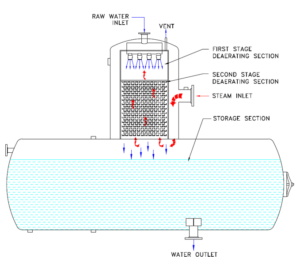
 Properly sizing a deaerator is critical to maintaining boiler efficiency, preventing corrosion, and ensuring reliable plant operation. An undersized unit can lead to oxygen carryover and poor thermal performance, while an oversized system unnecessarily increases capital and operating costs.
This guide walks through the key considerations and calculations required to correctly size a deaerator for your boiler system.
Steps to Sizing a Deaerator:
1. Determine Boiler Steam Demand
2. Determine Makeup Water Requirements
3. Determine Condensate Flow Rates and Return Temperatures
4. Size Storage Tank
5. Consider Operating Temperature and Pressure
6. Evaluate Vent Rate
7. Evaluate Oxygen Removal Requirements
8. Choose the Right Deaerator Type
What a Deaerator Does
A deaerator removes dissolved gases — primarily oxygen (O₂) and carbon dioxide (CO₂) — from boiler feedwater. These gases, if left untreated, cause corrosion in boilers, piping, and condensate systems. Deaerators accomplish this through a combination of mechanical separation and thermal heating, bringing water close to saturation temperature to drive off dissolved gases.
Step 1: Determine Boiler Steam Demand
Start with the maximum steam load your boiler system will require. This is typically expressed in lb/hr of steam.
- Use peak demand, not average.
- Include all connected loads (process, HVAC, sterilization, etc.).
- Consider if you should add a margin for future growth or load variability.
Example:
- Boiler capacity: (2) 300 HP steam boilers
- Total required capacity: 600 boiler HP x 34.5 = 20,700 #/hr
Step 2: Determine Makeup Water Requirements
Makeup water replaces losses in the system (leaks, vents, process use).
Formula:
Makeup Water = Feedwater – Condensate Return
Example:
- Condensate return: 80% of 22,000 = 17,600 lb/hr
- Makeup water: 23,100 – 17,600 = 5,500 lb/hr
This value is important because makeup water introduces the majority of dissolved gases that the deaerator must remove.
Step 3: Determine Condensate Flow Rates and Return Temperatures
Condensate return temperature is another critical consideration.
- Condensate returning at higher than deaerator operating temperature (typically 227° F at 5 psig) is considered high temperature condensate.
– This condensate will be adding heat to the DA tank and will reduce the total steam required to heat the makeup water.
– High temperature condensate does not typically need to be re-deaerated. - Condensate between 226° F and 196° F is considered medium temperature condensate.
– Medium temperature condensate requires some heating and deaeration when returning to the deaerator tank. - Condensate below 195° F is considered low temperature condensate.
– This condensate is typically pumped back to the deaerator from a vented condensate receiver and requires more heating and deaerating and is required to go back through the spray valve at the water inlet.
Systems with high percentages of medium and high temperature condensate are better served by a tray type deaerator. Systems with primarily cold makeup and low temperature condensate return can be handled by a spray type deaerator.
Step 4: Size Storage Tank
The deaerator storage section provides a buffer to handle load swings and ensure steady feedwater supply.
Typical storage guidelines:
- In the United States, 10 minutes of deaerated water storage to tank overflow is standard.
- In other countries, higher storage volume is common. More storage is needed for:
– Systems with fluctuating demand
– Poor makeup water reliability
– Large condensate return load swings (and no surge tank)
Formula:
Storage Volume (gallons) = (Feedwater lb/hr × minutes of storage) ÷ 500
Example (10 minutes storage):
- (20,700 #/hr × 10min) ÷ 500 ≈ 414 gallons
Step 5: Consider Operating Pressure and Temperature
Deaerators operate at a positive pressure with elevated water temperatures to remove dissolved gases effectively.
- Typical operating pressure: 5–12 psig
- Corresponding temperature: ~227–244° F
Ensure:
- Proper venting is included (to release stripped gases)
- Steam supply is sufficient for heating incoming water
Systems with a high percentage of high temperature condensate can be designed to operate at elevated temperatures/pressures to reduce energy losses due to condensate flashing.
Step 6: Evaluate Vent Rate
A deaerator must vent a small amount of steam to carry away released gases.
- Typical vent rate: .05% of the steam sent to the deaerator for deaeration purposes
- Underventing → poor gas removal leading to higher O₂ levels
- Overventing → energy loss
- Venting is one of the most critical things to ensure proper deaeration.
Keep Reading: Guide to Deaerator Venting: Troubleshooting & Calculating Deaerator Vent Rate
Step 7: Evaluate Oxygen Removal Requirements
Industry standard performance for pressurized deaerators:
- Oxygen content: ≤ 7 ppb (parts per billion)
- Pressurized deaerators offer superior deaeration performance when compared to atmospheric deaerators.
- BFS full line of deaerators offer deaeration levels to ≤ 7 ppb (parts per billion).
Step 8: Choose the Right Deaerator Type
Spray Type:
- Simpler design
- Lower cost
- Lower headroom required
- Suitable for systems with high makeup percentage and lower condensate return temperatures
Keep Reading: How Spray Type Deaerators Work
Tray Type:
- Better for large or high-pressure systems
- More consistent performance under varying loads
- Excellent turndown capability
- Suitable for systems with large percentage of high temperature returns
Keep Reading: How Tray Type Deaerators Work
Final Thoughts on Deaerator Sizing
Sizing a deaerator correctly is about more than matching boiler capacity — it requires a full understanding of your system’s mass balance, load variability, and water chemistry. A well-sized deaerator will:
- Extend equipment life
- Improve thermal efficiency
- Reduce chemical treatment costs
- Ensure stable boiler operation
BFS Industries Can Help
If you’re designing a new boiler system or upgrading an existing one, it’s worth validating your assumptions with actual operating data and consulting with one of BFS Industries’ experienced deaerator design engineers. Contact our team today to get started.